Why you shouldn't annualise an early-payment discount
A supplier offers a 1% discount to be paid 15 days earlier. Someone converts that to nearly 24% per year and concludes: far too expensive. The maths is right, the conclusion isn't.
The question we get a lot
It comes up in almost every conversation about early payment. As soon as the discount is converted into an annual interest rate, it sounds like an eye-wateringly expensive form of financing — more expensive than a bank loan. Understandable, because that’s how we’re used to weighing the price of money.
"A 1% discount for 15 days of early payment is the same as 24% interest per year. That's far too expensive."
There’s nothing wrong with the maths. But annualising a one-off discount measures something that doesn’t actually happen — and so it gives a distorted picture.
Where the reasoning goes wrong
An annual interest rate assumes you borrow the same amount all year long, again and again, on that condition. With early payment, that isn’t what happens. It’s one discount, on one invoice, for the short period that payment is brought forward. After that, it’s done.
Annualised
Actual cost
On an invoice of € 10,000, a 1% discount is simply € 100. That’s the real price of getting your money 15 days earlier — not € 2,430. That annualised percentage only exists on paper.
A comparison that makes it clear
The car park
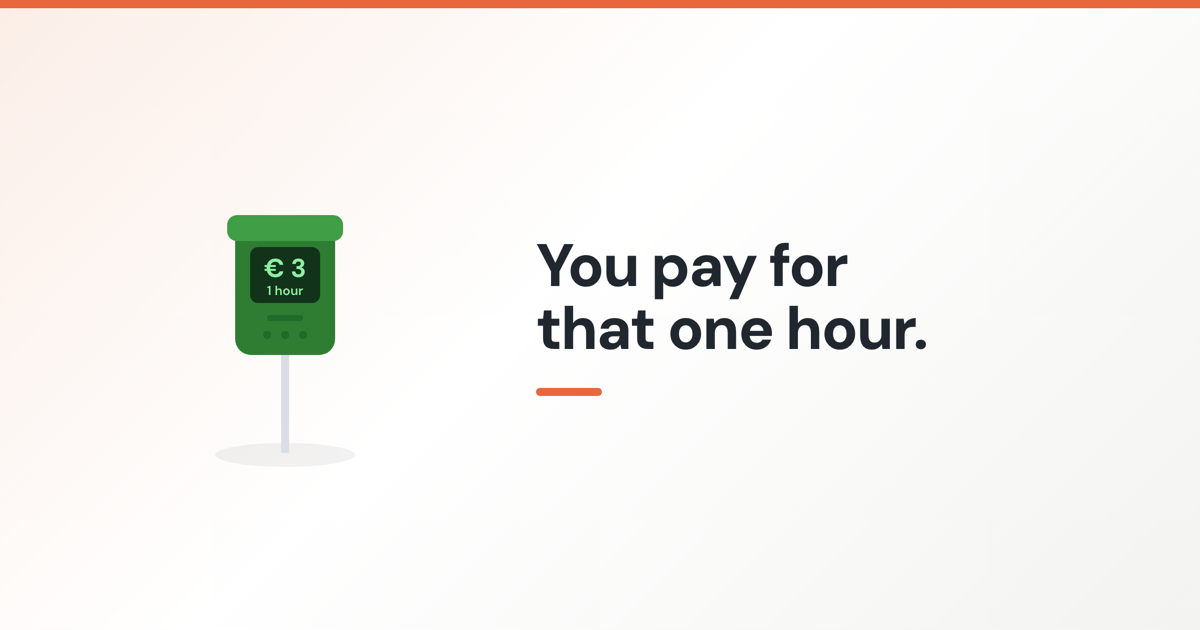
Say you pay € 3 to park for an hour. Nobody says: 'that's € 72 a day, or well over € 26,000 a year — far too expensive!' You only park for that one hour. Early payment works exactly the same way: you pay for the service you use, at the moment you use it.
Why suppliers choose it on purpose
Precisely because it’s a small, one-off discount, early payment is attractive for many suppliers:
- The discount is often lower than their own financing costs — cheaper than an overdraft, factoring or a revolving credit.
- They decide themselves, per invoice, whether to accelerate whenever it suits them.
- The money is available straight away — for an investment, a peak in working capital, or simply for peace of mind.
- No application, no assessment: the invoice is already approved, so the payout is certain and fast.
The rate scales in proportion
At NCN Capital the sliding scale works with an adjustable level — take 2% per 30 days as an example. The discount moves neatly in step with how much earlier payment is made — shorter means less, longer means more:
One nuance the other way round: anyone who puts their working capital to work continuously, accelerating invoice after invoice, may think in annual returns — because then the benefit does repeat each time. You can read that perspective in What does paying earlier get you?
An early-payment discount is the price of one service, on one invoice — not an annual rate that keeps repeating. Reckon it for what it is: a small, one-off amount for the comfort of getting your money earlier.