
Paying your supplier later — with a premium
How to keep your working capital in-house longer by letting your supplier choose to be paid later against a premium — and why that is something other than stretching your payment term.
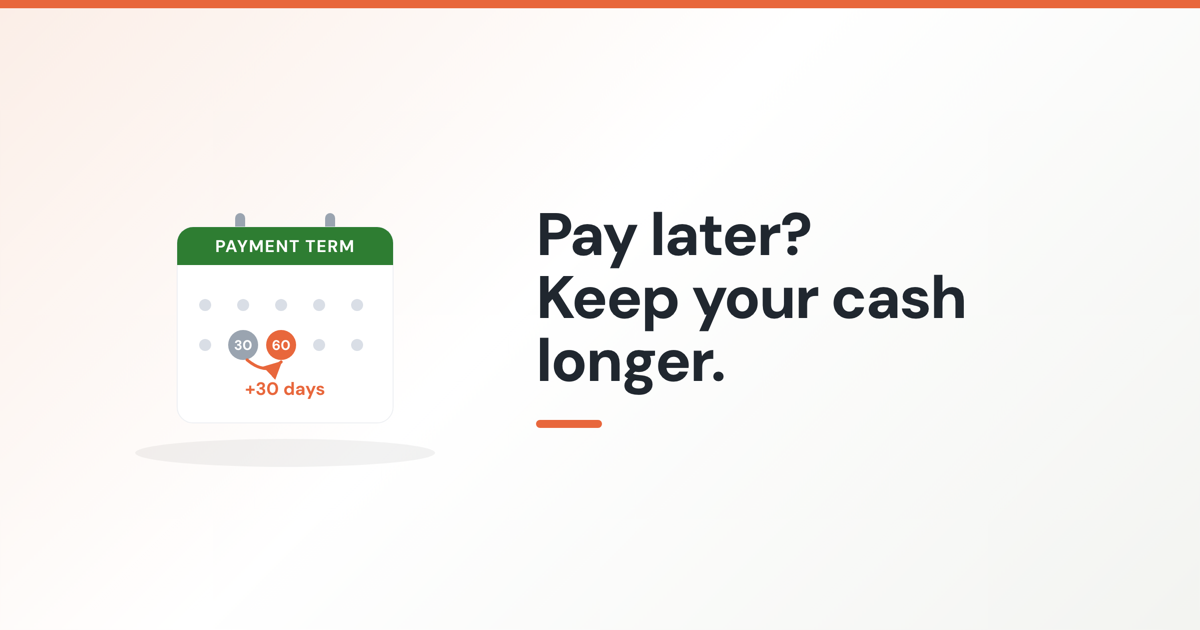
Sometimes you want to hold on to your money a bit longer — smooth out a spike in your spending, or get some breathing room in your working capital. You can, without cornering your supplier. You turn it into a tidy, paid arrangement: your supplier is paid later and earns from the wait.
You offer your supplier the option to be paid later against a premium. He chooses a date after the due date himself; the later he chooses, the higher the premium he receives. If he chooses nothing, you simply pay on the due date — no one is cornered.
Who does what
The choice lies with your supplier; the benefit for your cash flow lies with you.
Paid later, against a premium
Working capital in-house longer
You set the premium, your supplier the date
You set for yourself what premium you pay at most for thirty days later — for example 2%. Your supplier then chooses the date; the later he chooses, the higher his premium, sliding from almost nothing up to your maximum:
Example: you set the maximum at 2% for thirty days later. If your supplier chooses nothing, nothing changes about the original arrangement.
The difference with simply paying later
Having your money longer can also be done the old-fashioned way: stretching your payment term or simply letting the invoice sit. That works out very differently.
Your supplier waits — for nothing
Your supplier says yes himself
Here you are not buying time off your supplier — you are paying him for it. That changes the nature of the conversation: from "can it be a bit later?" to a choice that he is better off for.
What you use this for
Think of it as financing your working capital, per invoice and without a facility. You use it when you want to smooth out a spike in your spending, or when the premium works out more favourably than your overdraft. And because it is financing, you calculate it as such:
Every 1% premium for thirty days longer ≈ ~12% annualised (1% × 365 ÷ 30). The premium scales with the number of days, so compare it with your financing costs — not with zero.
So paying later does cost money; the difference is that you pay it to your supplier instead of to the bank, and that your supplier chooses it himself.
The percentages mentioned are illustrative, to show the conversion. The actual premium varies per situation.
You keep your working capital in-house longer and your supplier chooses it himself and earns from the wait — a flexible form of financing per invoice, with a price fixed in advance.
Curious how the platform arranges the timing of your payments? Read on about Dynamic Discounting.
This is one of four situations on the same calendar — earlier or later, discount or premium. The overarching picture is in One calendar, one principle.