Paying later is allowed — and you earn from it
How to give your customers room to pay later against a premium that you receive — and why it also gets you paid neatly on time more often.
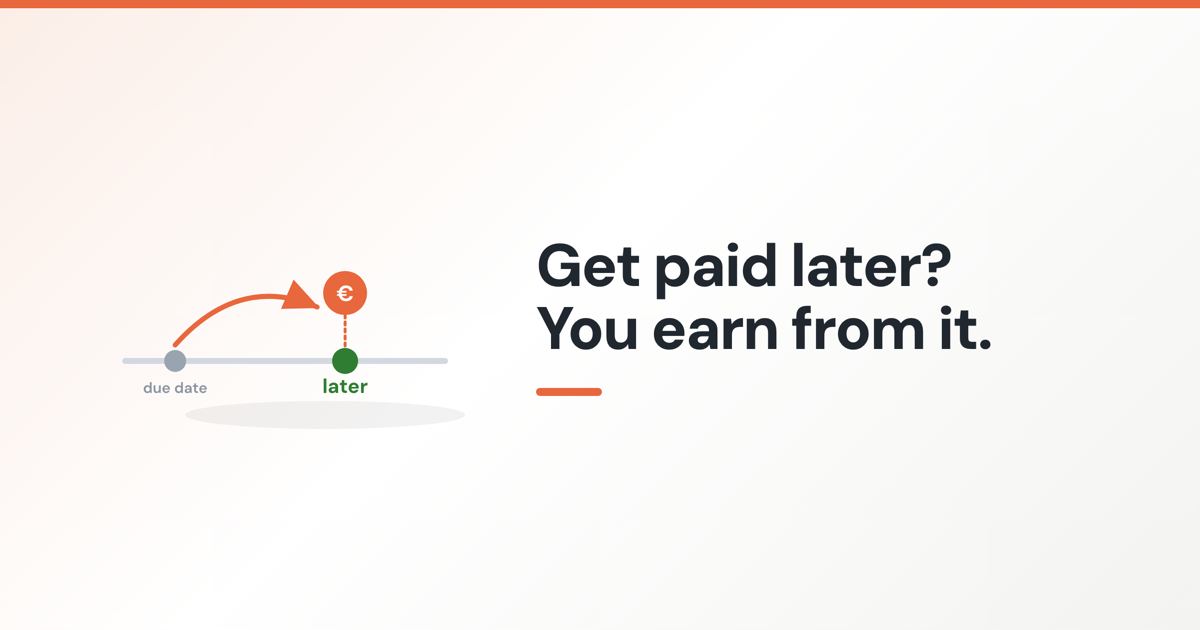
Sometimes a customer would rather pay a bit later — some breathing room in his own cash flow. Normally that means a phone call, a discussion, or simply a payment that comes in too late. On the platform you turn it into a tidy, paid option: paying later is allowed, but against a premium. And that premium goes to you.
You give your customer the option to choose a day in the calendar after the final payment date. The system calculates the matching premium. Your customer pays that premium on top of the invoice amount — and that is exactly what you earn from it.
Who does what
This is the only button where the money comes your way: your customer gets breathing room, you get a return on a receivable you already had.
Pay later, against a premium
Return on your receivable
You set the premium
You send the invoice, so you keep control. You set for yourself what premium you ask at most for paying thirty days later — for example 2%. Your customer then chooses a date himself; the later he pays, the higher the premium, sliding from almost nothing up to your maximum:
Example: you set the maximum at 2% for thirty days later. The premium runs from 0.1% just after the due date up to 2.0% as your customer pays later.
What it delivers
The premium is a return on a receivable you had anyway. Let’s fill it in, purely as an illustration: a customer pays an invoice of € 100,000 twenty days later, against a premium of ~1.3%. That earns you roughly € 1,300 — on money that was coming in anyway.
No collection hassle, no separate process. It runs per invoice through your existing invoices and ERP. Your customer decides himself, you receive the compensation.
The clever side effect
There is a nice psychological effect to this button that you might not immediately expect.
The moment your customer sees the option to — for a fee — pay later, the due date suddenly becomes tangible. Anyone who does not want to pay that premium has a concrete reason to simply pay on time. So you win both ways:
- Does your customer choose to pay later? Then you earn a premium on your receivable.
- Does he choose not to? Then the premium is exactly the reason he pays neatly on the due date.
- Both good for your cash flow — and you have to do nothing for it.
Offer your customer the room to pay later, and you win either way: earn a premium if he chooses it, or get paid neatly on time more often if he doesn't.
Curious what this does for your cash flow? Read on about SmartDSO — ready to start straight away, without a long-term contract.
This is one of four situations on the same calendar — earlier or later, discount or premium. The overarching picture is in One calendar, one principle.