
Knowledge session with Du Prie: balance-sheet optimisation for the annual figures
During our first knowledge session, Marc van Nassau of Du Prie bouw & ontwikkeling shared his insights on liquidity and keeping the annual figures stable.
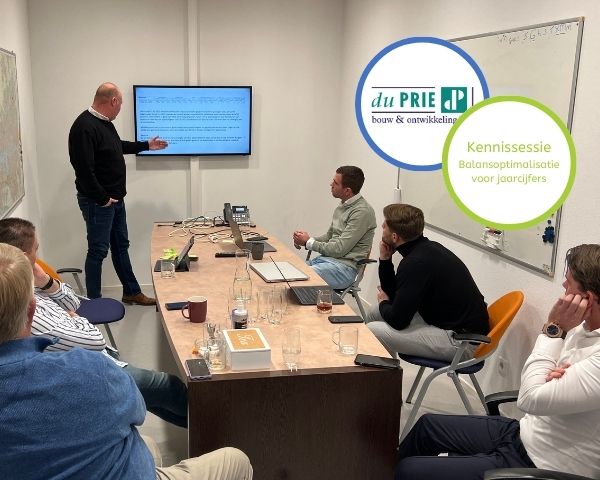
Knowledge is a valuable asset. Without it we get nowhere — whether it’s a manufacturing company, a consultancy firm or a healthcare institution. And we feel the same way at NCN Capital. As we already indicated in our New Year outlook, we organise knowledge sessions with this in mind. The pilot version of this initiative took place at the end of December. Marc van Nassau of Du Prie bouw & ontwikkeling b.v. led the session on a theme close to his heart: balance-sheet optimisation for the annual figures.
In this brief report, we take you through the key lessons for our team.
About Du Prie and Marc van Nassau
Du Prie bouw & ontwikkeling is a family business with around 100 employees. The construction company is active in commercial construction, housing, renovation, restoration and property development. The third generation is currently at the helm. A healthy company and safeguarding continuity rank high on their agenda. As a developing construction company, they understand precisely the wishes and expectations of their clients.
Marc van Nassau is a financial controller at Du Prie. He has also specialised in building and implementing information systems that connect to the financial administration.
A healthy construction chain through optimal liquidity
Marc likes to stay ‘ahead of the game’. That means timely payment — both by his customers to him and by him to his suppliers. To that end he keeps in close contact with both customers and suppliers and coordinates when invoices are sent out. After all, a construction company benefits from good contact with clients and suppliers. Is there close and good contact with clients? Then they are more inclined to settle outstanding invoices sooner. This in turn lets the construction company pay its suppliers’ invoices faster. And that again influences the contact with suppliers, their willingness to keep delivering and their satisfaction.
It’s his way of making sure that at least Du Prie’s part of the chain stays healthy in the sector. Liquidity starts flowing, the companies in that chain know where they stand and have a healthy financial position. If the whole industry worked this way, the sector would be completely healthy in no time.
Keep the annual figures stable
Another of Marc’s aims concerns the annual figures. The goal: maintain stability and limit fluctuations compared with previous years. Annual figures that fluctuate too much arouse suspicion among stakeholders and cause unrest. Also when the organisation regularly takes part in tenders, it’s important that figures such as solvency and the current ratio are comparable.
Wanting to keep them stable is one thing; actually managing it is another. Marc has his own strategy for this. He makes sure he sends out all invoices by November at the latest. So the year-end close effectively begins a month earlier. That way he knows what is still outstanding and what is being paid. If he receives a large invoice at the last minute that could materially affect the balance-sheet total, he anticipates it in December. So December is entirely devoted to keeping the balance-sheet total and the annual figures in order — and no longer to chasing outstanding invoices.
Pay suppliers from funds received and not from equity. That way you don't withdraw equity from the company, the balance-sheet total stays the same, and the current ratio and solvency remain stable.
On to the next knowledge session
Not all of our employees are trained in business economics. Through sessions like these they learn a bit of theory, but above all how it works in practice. After the session on balance-sheet optimisation with Marc van Nassau, the reactions were unanimously enthusiastic. The team is already eagerly looking forward to the next session.
We’re still looking for a guest speaker — and maybe that’s you? Do you have an interesting theme, a particular focus you apply or a working method of your own? Let us know, and who knows, you might bring our team’s knowledge up to speed.